I really like what the folks over at juice analytics put together to visualize del.icio.us posts over time. They call the post "My year in attention (and yours)".
I still think the idea of using del.icio.us to track attention is spot on. With del.icio.us, you're not only tracking what you are paying attention to over time, but you're also adding dimension (tags) to your attention that should be worth something to marketers (and not just Yahoo's marketers). Del.icio.us is well positioned to be a very big leader in the attention market.
On a slightly different topic, but still related to analytics, check out what juice analytics did with a flash-based representation of data over time - it's also mocked up using Excel. Clever.
Friday, January 06, 2006

Tuesday, January 03, 2006
Moving Bloglines
Mark Fletcher (founder of Bloglines and ONElist) has written several articles and presented information on web application operations issues and growing pains over the past year or so. In December, Bloglines moved to a new datacenter (new for them anyway...close to the rest of the Ask team). Mark writes several posts on the experience. Start with Part 1.
Filed in: operations bloglines
Thursday, December 15, 2005
Web Analytics and Feeds #2: The Players
Take a look at the list of exhibitors and sponsors of Syndicate, going on right now in lovely San Francisco. How many web analytics vendors do you see on the list? None? Any bets on what that list might look like at next year's conference?
There are many companies there who are building analytics solutions. Take a look at some of the approaches these folks are taking. Very creative ideas indeed.
There are many companies there who are building analytics solutions. Take a look at some of the approaches these folks are taking. Very creative ideas indeed.
Tuesday, December 13, 2005
Web Analytics Data Changing User Behavior?
Many of us are familiar with providing web analytics data via an overlay. I believe Fireclick was first to this party with their Site Explorer tool...WebTrends has a product called SmartView...other vendors have their own versions as well. This rich analytics data has historically been viewed only by those using these analytics tools.
Whether or not you like the term Web 2.0, many of the new implementations of the web-as-a-platform are changing how we think of analytics. Ajax is changing how we think of tracking visitors, visits and views. API's are opening up everywhere, providing a healthy exchange of data. Del.icio.us is my favorite example of a disruptive tool, as they change our paradigms of saving, sharing and searching.
So, how about web analytics? What's new and interesting and disruptive in our world? Here's one approach that I like. Mybloglog.com, previously noted here, looks to have an API that shows a lot of promise. I can't find any information on their site about it, but you can see an example of what they're doing at this cool Del.icio.us tool site (hover over the links in the article).

Wow. Are visitors more likely to click on the links that are rated higher, thus changing visitor behavior? Perhaps so. Amazon has done this for years. Others do as well, but I've not seen someone directly using web analytics data to do this before. Are there other examples out there?
Whether or not you like the term Web 2.0, many of the new implementations of the web-as-a-platform are changing how we think of analytics. Ajax is changing how we think of tracking visitors, visits and views. API's are opening up everywhere, providing a healthy exchange of data. Del.icio.us is my favorite example of a disruptive tool, as they change our paradigms of saving, sharing and searching.
So, how about web analytics? What's new and interesting and disruptive in our world? Here's one approach that I like. Mybloglog.com, previously noted here, looks to have an API that shows a lot of promise. I can't find any information on their site about it, but you can see an example of what they're doing at this cool Del.icio.us tool site (hover over the links in the article).

Wow. Are visitors more likely to click on the links that are rated higher, thus changing visitor behavior? Perhaps so. Amazon has done this for years. Others do as well, but I've not seen someone directly using web analytics data to do this before. Are there other examples out there?
Filed in: analytics technology
Monday, December 12, 2005
Web Analytics and Feeds #1: Feedburner
First in a series on analyzing feeds...
Feedburner is an excellent service for bloggers. They provide some terrific tools to easily expand the presence of a blog. They have methods to help publicize, optimize, monitize, analyze and yes, even troubleshootize (honest!) your feed.
Analysis Tools
Their free analysis tools are fairly simple, but quite useful. Feed Circulation gives me an aggregate number of subscribers on a daily basis. Since they provide this stat through their Awareness API too, I have a widget on my desktop that gives me my updated number each day.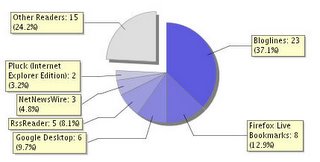 They also provide a further breakdown of my Readership, showing the number of subscribers by reader. Note: now that 23 of you subscribe via Bloglines, according to nice folks over at Ask Jeeves...this is a blog that matters (although, they've probably upped the requirement since October's Web 2.0 conference :-)
Collecting Feed Subscribers
Getting this data from Feedburner is very handy, but I wanted to tie back my subscribers to the Feedburner feeds to my other analysis tools. There are a couple of ways to do this, but the simplest method is to add an image request into Feedburner's "Feed Image Burner", as shown below.
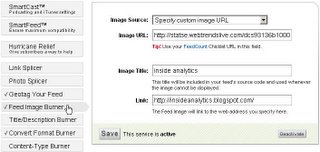
This is normally used to provide an image to readers when displaying articles, but I hijacked this image location to add an analytics image request. Geek note: In RSS 2.0, this image is in channel->image->url, in Atom, I believe the atom:logo element would work the same. In order to include requests for my feed in my web analytics data, I modified the "noscript" image request from my WebTrends code to insert into the "Image URL" field. The image request looks like this:
Cool. This gives me a separate breakdown in my WebTrends reports showing requests to the URI "Feedburner.feed". Requests to the image are made when someone actually reads the feed, not when the reader picks up the feed. (Note: I'll figure out an equivalent URL for MeasureMap and Google Analytics, and post that in case anyone is interested.)
Feedburner Issue
Back to Feedburner. I noticed an issue that I need to research further. I was originally using their "SmartFeed" service to translate the feed format to be compatible with the subscriber's application. It seemed to strip out the image, even though it showed it correctly inserted in the "XML Source" in the Feedburner UI. I disabled the SmartFeed service, and set the "Convert Format Burner" to RSS 2.0, and all worked great. I can now analyze when the feeds are viewed in a reader (for those readers that display an image of course).
More complications
There's more to this story. I now have some visibility into (at least a partial list of) who is reading my feeds. But, are they visiting the site? More on this conversion in a subsequent post...
Feedburner is an excellent service for bloggers. They provide some terrific tools to easily expand the presence of a blog. They have methods to help publicize, optimize, monitize, analyze and yes, even troubleshootize (honest!) your feed.
Analysis Tools
Their free analysis tools are fairly simple, but quite useful. Feed Circulation gives me an aggregate number of subscribers on a daily basis. Since they provide this stat through their Awareness API too, I have a widget on my desktop that gives me my updated number each day.
 They also provide a further breakdown of my Readership, showing the number of subscribers by reader. Note: now that 23 of you subscribe via Bloglines, according to nice folks over at Ask Jeeves...this is a blog that matters (although, they've probably upped the requirement since October's Web 2.0 conference :-)
Collecting Feed Subscribers
Getting this data from Feedburner is very handy, but I wanted to tie back my subscribers to the Feedburner feeds to my other analysis tools. There are a couple of ways to do this, but the simplest method is to add an image request into Feedburner's "Feed Image Burner", as shown below.

This is normally used to provide an image to readers when displaying articles, but I hijacked this image location to add an analytics image request. Geek note: In RSS 2.0, this image is in channel->image->url, in Atom, I believe the atom:logo element would work the same. In order to include requests for my feed in my web analytics data, I modified the "noscript" image request from my WebTrends code to insert into the "Image URL" field. The image request looks like this:
http://statse.webtrendslive.com/dcs93136b10000004rrmeb3jo_5u5i/njs.gif?
dcsuri=/Feedburner.feed&WT.js=No&WT.ti=FeedBurnerFeed
Cool. This gives me a separate breakdown in my WebTrends reports showing requests to the URI "Feedburner.feed". Requests to the image are made when someone actually reads the feed, not when the reader picks up the feed. (Note: I'll figure out an equivalent URL for MeasureMap and Google Analytics, and post that in case anyone is interested.)
Feedburner Issue
Back to Feedburner. I noticed an issue that I need to research further. I was originally using their "SmartFeed" service to translate the feed format to be
 compatible with the subscriber's application. It seemed to strip out the image, even though it showed it correctly inserted in the "XML Source" in the Feedburner UI. I disabled the SmartFeed service, and set the "Convert Format Burner" to RSS 2.0, and all worked great. I can now analyze when the feeds are viewed in a reader (for those readers that display an image of course).
More complications
There's more to this story. I now have some visibility into (at least a partial list of) who is reading my feeds. But, are they visiting the site? More on this conversion in a subsequent post...
Filed in: analytics feedburner rss
Friday, December 09, 2005
Google Transit - WA Wednesday
Another great idea from the "20% percent time" policy Google offers its engineers. This one pulls together transit schedules and Google Maps in a very slick mashup.
They chose Portland for the first launch. Those of us who live in Portland know the Tri-Met transit system is excellent. Google puts it this way in their blog:
Fantastic stuff. Oh, and if you're downtown next Wednesday evening and need to get to the Lucky Labrador for the Web Analytics Wednesday chat, this link might help.
Or, if you're out near Intel in Hillsboro today and want to get downtown to see the national champion Portland Pilots women's soccer team celebration at noon, try this.
They chose Portland for the first launch. Those of us who live in Portland know the Tri-Met transit system is excellent. Google puts it this way in their blog:
We chose to launch with the Portland metro area for a couple of reasons. Tri-Met, Portland's transit authority, is a technological leader in public transportation. The team at Tri-Met is a group of tremendously passionate people dedicated to serving their community. And Tri-Met has a wealth of data readily available that they were eager to share with us for this project. This combination of great people and great data made Tri-Met the ideal partner.
Fantastic stuff. Oh, and if you're downtown next Wednesday evening and need to get to the Lucky Labrador for the Web Analytics Wednesday chat, this link might help.
Or, if you're out near Intel in Hillsboro today and want to get downtown to see the national champion Portland Pilots women's soccer team celebration at noon, try this.
Tuesday, December 06, 2005
Kanoodle Has It Backwards
ClickZ reports that Kanoodle is going to pay publishers to distribute their "targeting" cookies. Kanoodle's BrightAds program says:
I'll give them an A for creativity, and for trying to amass an internet-visitor database as only Google can do right now (with Yahoo close behind).
However, this program is doomed for a couple of reasons. The most obvious reason is that third party cookies are dying a quick death. My own personal prediction is that third party cookies will be useless by the end of 2006. Since this program relies on third party cookies, they're data will be useless.
The second reason this effort will fail is because they (and others) won't be able to "own" visitor data...visitors will. AttentionTrust efforts will put preference data in the hands of visitors, which will fundamentally alter the advertising approach taken by these companies. 2006 will be an interesting time for Attention...
"Add our code to your page, and we'll drop cookies, so when a user visits another site in the Kanoodle network, we can show them ads that will appeal to them."
I'll give them an A for creativity, and for trying to amass an internet-visitor database as only Google can do right now (with Yahoo close behind).
However, this program is doomed for a couple of reasons. The most obvious reason is that third party cookies are dying a quick death. My own personal prediction is that third party cookies will be useless by the end of 2006. Since this program relies on third party cookies, they're data will be useless.
The second reason this effort will fail is because they (and others) won't be able to "own" visitor data...visitors will. AttentionTrust efforts will put preference data in the hands of visitors, which will fundamentally alter the advertising approach taken by these companies. 2006 will be an interesting time for Attention...
Subscribe to:
Posts (Atom)